Your Fitness Tracker Is Watching You Breathe — And It's Not As Helpful As You Think
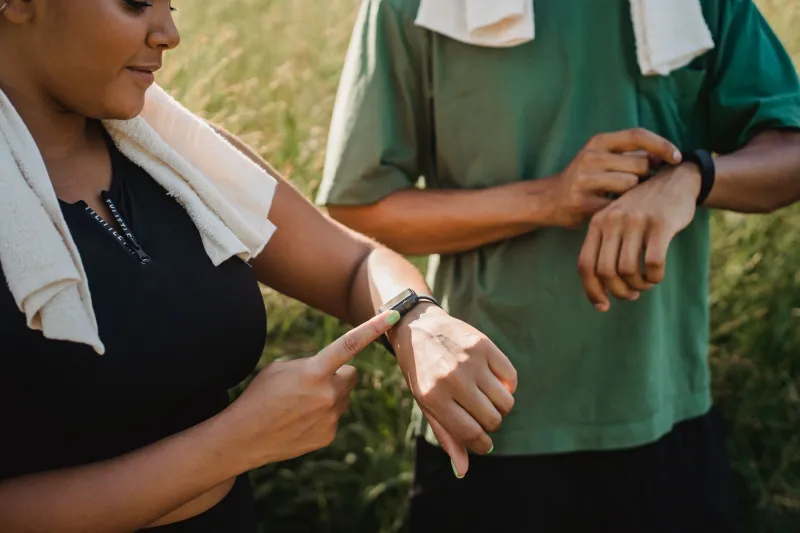
Let's start with a moment you've probably lived.
You wake up, and before you've had water, before you've looked out the window, before you've even fully decided to be conscious — you check your sleep score. It's a 61. Suddenly, a morning that felt okay feels like a problem you need to solve. You weren't tired until the app told you that you should be.
Welcome to the wellness industrial complex, where the product is optimization and the raw material is you.
The Promise Was Simple. The Reality Got Complicated Fast.
When fitness trackers first landed in the mainstream, the pitch was genuinely appealing: know your body better, move more intentionally, sleep smarter. For people who'd spent years disconnected from their physical selves — grinding through desk jobs, eating lunch at their keyboards, treating rest as a reward they hadn't earned yet — the idea of having a little coach on your wrist felt almost revolutionary.
And to be fair, for some people, that nudge worked. Step counts went up. People started noticing patterns. There's real value in data when it opens a door to self-awareness.
But something shifted. The apps got more sophisticated. The metrics multiplied. Now we're not just tracking steps — we're monitoring heart rate variability, blood oxygen saturation, stress response curves, readiness scores, recovery windows, and something called "body battery" that sounds less like wellness and more like a smartphone charging update.
At some point, knowing your body became managing your body. And managing your body became a part-time job you never applied for.
Dopamine Is the Business Model
Here's what the wellness tech industry doesn't put in its marketing copy: these platforms are designed using the exact same behavioral psychology as social media. Streaks, badges, leaderboards, daily goals with satisfying little animations when you hit them — every element is engineered to keep you coming back, keep you checking, keep you engaged.
That's not an accident. It's the architecture.
When you close your rings or hit your move goal, your brain releases a small hit of dopamine. When you fall short, there's a low-grade anxiety that nudges you to try harder tomorrow. Over time, your sense of physical wellbeing stops being something you feel in your body and starts being something you read off a screen.
This is what researchers sometimes call metric fixation — the tendency to mistake the measurement for the thing being measured. You're no longer asking "do I feel rested?" You're asking "what did my app say about my sleep?" These are not the same question. One requires you to be present in your own body. The other outsources that knowing entirely.
And Then There's the Data Problem Nobody Talks About
Let's be direct about something that gets glossed over in the wellness space: when you use these apps and devices, you are generating an extraordinarily intimate data profile. Your resting heart rate. Your menstrual cycle. Your stress levels at 2am. Your location every time you go for a run.
Who owns that? In most cases, not you.
The privacy policies of major wellness platforms — and yes, we're talking about the ones with the prettiest interfaces and the most devoted communities — often include language that allows your data to be shared with third parties, used for research, or retained indefinitely even after you delete your account. Some of that data has ended up with insurance companies. Some has been subpoenaed in legal proceedings. Some has simply been sold.
The wellness industry has done a masterful job of making health tracking feel personal and empowering while quietly building one of the most detailed behavioral databases in human history. Your body is the product. Your anxiety about your body is what keeps you subscribed.
What We Lose When We Stop Trusting Ourselves
There's a subtler cost here that's harder to quantify but worth sitting with.
When you consistently outsource the interpretation of your physical experience to an algorithm, you gradually lose confidence in your own body literacy. You stop trusting the signals your nervous system has been sending you since birth. You start needing external validation to confirm what your body is already telling you.
In yoga, we talk a lot about pratyahara — the practice of withdrawing attention from external stimulation and turning it inward. It's one of the eight limbs of yoga, and it's genuinely countercultural right now. Because the entire wellness tech ecosystem is built on the opposite principle: constant external feedback, constant measurement, constant optimization.
Real body awareness — the kind that actually serves your long-term health — is quiet. It's the ability to notice that you're holding tension in your jaw before it becomes a headache. It's recognizing that you're running on fumes two days before you crash. It's knowing when you need stillness versus when you need movement, without a readiness score to tell you.
That kind of knowing takes practice. And it's almost impossible to develop when you're constantly looking at a screen for answers.
The Case for Going a Little More Analog
None of this means you have to throw your watch into the East River. But it's worth asking, honestly, whether the tools you're using are actually making you healthier or just making you more vigilant.
Some things worth trying:
Leave the tracker at home for a workout. Notice what happens when you run or practice without knowing your pace, your heart rate, your calorie burn. Can you still gauge your effort? Can you still feel the difference between pushing and coasting? Probably yes — and that's useful information about how much you've already internalized.
Journal instead of track. At the end of the day, write two sentences about how your body felt. Not numbers. Not metrics. Just language. This builds a different kind of self-knowledge — one that's yours, that no company can access, and that actually requires you to be present.
Take a data fast. Pick one week and don't look at your health app stats. Notice what anxiety comes up. Notice whether your behavior actually changes without the feedback loop. The discomfort itself is data — about how dependent the system has made you.
Practice asking your body first. Before you check your sleep score, ask yourself how you actually feel. Before you look at your stress graph, take a breath and notice what's happening in your chest. This sounds almost embarrassingly simple, but it's a radical act in a culture that's trained you to distrust your own experience.
You Already Know More Than You Think
Your body has been communicating with you your entire life. It knows when it's tired. It knows when it's hungry. It knows when something is off, often weeks before any tracker would flag it. The question isn't whether your body has useful information — it absolutely does. The question is whether you've been conditioned to ignore that signal in favor of a cleaner, more gamified version of the truth.
Wellness that actually works isn't optimized. It's not scored. It doesn't require a subscription.
It's built slowly, in the quiet space between the notifications, when you're finally paying attention to the one device that matters most — the one you were born with.