The Green Doesn't Fix It: Why Living Near the Water Still Leaves You Wired
Let's be honest about something that doesn't get said enough in wellness circles: location is not a cure.
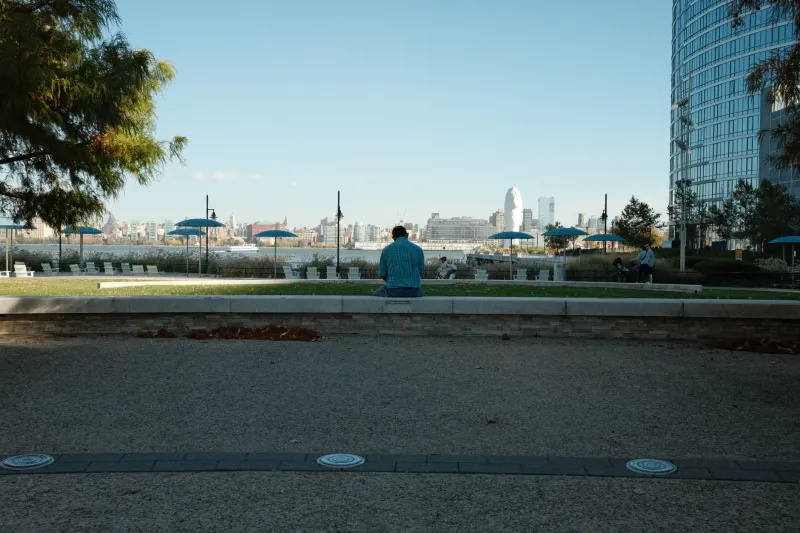
You made the move. Maybe it was from a noisier neighborhood, a more chaotic borough, or a city altogether different from New York. You found your place in Astoria — with Astoria Park literally down the street, the East River glittering on clear mornings, Socrates Sculpture Park doing its dreamy thing on weekends. You figured the greenery would do something to your nervous system. You figured proximity to calm would eventually become calm itself.
And yet. Here you are. Still wired at 11pm. Still grinding your jaw on the subway. Still waking up before your alarm with that low-grade, nameless dread.
You are not broken. But you might be waiting for something that was never going to show up on its own.
Why We Believe Place Will Save Us
There's a deeply human instinct to believe that changing our surroundings will change our inner experience. It's not irrational — it's actually rooted in real science. Research consistently shows that access to green space, natural light, and water can lower cortisol, reduce blood pressure, and improve mood. Nature is genuinely good for you. This isn't wellness marketing fiction.
But here's the catch: those benefits are dose-dependent, and they require your nervous system to actually receive them. If you're walking past the waterfront while mentally composing a passive-aggressive email response, your brain isn't registering the river. It's registering the conflict. The scenery becomes wallpaper.
We move somewhere beautiful and assume the beauty will do the work. What we underestimate is how much of our internal weather we carry with us — packed right alongside the boxes of books and the yoga mat we swore we'd use more.
The Nervous System Doesn't Care About Your View
Your autonomic nervous system — the part of you that runs the fight-or-flight and rest-and-digest responses — is not impressed by real estate. It responds to perceived safety, not actual scenery. And if your baseline is chronic stress, your system has likely been recalibrated to treat threat as the default setting.
This is called allostatic load. Basically, it's the cumulative wear on your body from sustained stress over time. When you've been running on high alert for months or years — financial pressure, relational strain, job insecurity, the ambient anxiety of just existing in America right now — your nervous system doesn't suddenly downshift because you moved somewhere with better park access.
It's like trying to cool down a car engine by changing the road you're driving on. The engine doesn't care about the road.
What actually shifts the nervous system? Consistent, intentional practices that signal safety to your body. Slow, deliberate breath. Movement that isn't punishing. Rest that isn't guilty. Social connection that feels real. And time — genuine, unscheduled, unoptimized time in nature, not a 20-minute power walk with your AirPods in.
The Difference Between Access and Practice
Astoria hands you a lot. That's the paradox. The park is there. The waterfront is there. The yoga studios (hi, hello, we see you) are there. But access is not the same as practice, and this distinction matters enormously.
Practice requires intention. It requires you to actually show up — not just physically, but mentally. To sit by the water without your phone for long enough that your brain stops generating its to-do list and starts noticing the way light moves. To take a yoga class and actually breathe instead of performing the poses for an imaginary audience. To walk through Astoria Park without a destination, without a podcast, without a reason other than letting your body remember what it feels like to not be in a hurry.
This is harder than it sounds. We live in a culture that has commodified even stillness. There's an app for your meditation, a playlist for your nature walk, a supplement for your cortisol. All of it is subtly reinforcing the message that you need to do calm rather than allow it.
Allowing is the skill. And it's the one most of us were never taught.
What Actually Needs to Shift
If you've been waiting for Astoria to fix your anxiety, here's some gentle but direct news: the neighborhood is ready when you are. The work isn't outside. It's in the gap between stimulus and response — that tiny space where you can choose, just for a moment, not to react from habit.
Some places to start:
Get your body out of performance mode. A lot of us use exercise as another form of stress, not a release from it. If your yoga practice feels like a test, if your runs feel like punishment, if you're tracking every metric and judging the results — your nervous system is not recovering. It's just stressed in different clothes. Try one session a week with zero metrics. No pace, no calories, no progress photos. Just movement for the sake of moving.
Use the park like medicine, not a backdrop. Sit down. Take your shoes off if the ground is dry enough. Spend ten minutes doing nothing except noticing what's around you. This is not wasted time. This is literally what your nervous system needs to begin downregulating. The Japanese call it shinrin-yoku — forest bathing — and the research behind it is solid. You don't need a forest. Astoria Park will do just fine.
Breathe like you mean it. Not the vague, aspirational breathing you do when someone reminds you to breathe. Real, slow, diaphragmatic breathing — in through the nose for four counts, hold for four, out through the mouth for six to eight. Do this for five minutes before you open your phone in the morning and watch what happens to your baseline over a few weeks. It sounds too simple to matter. It is not.
Stop outsourcing your regulation. Wine, scrolling, binge-watching, online shopping — these are all forms of nervous system management that work briefly and borrow against your future calm. They're not villains, but they're not solutions either. Notice when you reach for them and ask what you're actually trying to feel (or not feel).
The Invitation You Already Said Yes To
You moved here for a reason. Something in you recognized that you needed a different relationship with your environment, your body, your life. That instinct was good. That instinct was right.
But the neighborhood was always just the invitation. You still have to walk through the door.
Astoria's parks and waterways are genuinely remarkable resources — and they will meet you exactly where you are, every single time you show up. They don't judge your consistency. They don't care if it's been weeks since you sat by the river. They just keep being there, quiet and available, waiting for you to remember that calm isn't something you find.
It's something you practice until it finds you back.