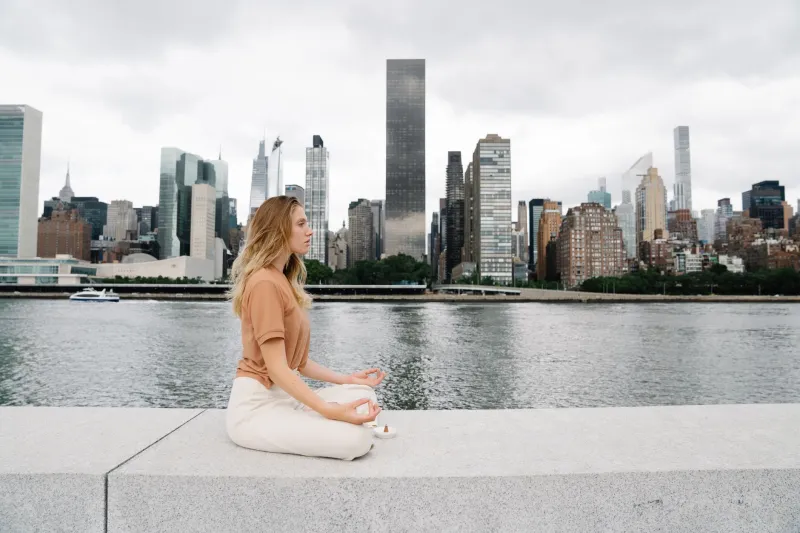
Performing Wellness vs. Practicing It: Why Sunday Rituals Aren't Saving You

Sunday rolls around and you've got the whole thing mapped out. A slow morning, maybe a sheet mask, definitely a $9 oat milk latte from that place on Steinway. You'll do a little journaling, maybe pull up a 20-minute yoga flow on YouTube, and spend the evening meal-prepping for the week. By Monday morning, you're supposed to feel restored. Recharged. Ready.
Except you don't. You feel exactly as wrung out as you did Friday afternoon, maybe with slightly smoother skin.
If this sounds familiar, you're not alone—and more importantly, you're not failing at self-care. You might just be performing it instead of practicing it.
The Aesthetic Trap Is Real (And It's Expensive)
Astoria is a neighborhood of doers. Greek families who've run the same bakery for three generations. Immigrant communities that built entire economies from scratch. Young professionals grinding through two-hour subway commutes to Manhattan offices. We are, culturally speaking, not great at rest. We're great at looking like we're resting.
Social media didn't invent the performance of wellness, but it definitely turbocharged it. When self-care becomes content—when the bath bomb photo matters as much as the bath itself—the ritual stops serving you and starts serving an audience. Even if that audience is just the imagined version of yourself you're trying to convince that you have it together.
The result? A lot of us are spending real money and real time on wellness theater. The candles, the supplements, the Sunday routines that look great in a grid but don't actually touch the anxiety that's been sitting behind your sternum since Wednesday.
What Behavioral Science Actually Says About Habit Change
Here's the thing about sustainable habits: they're almost aggressively boring. Researchers who study behavioral change consistently find that the rituals most likely to stick are small, specific, and attached to something you're already doing—not grand, aesthetic, once-a-week resets.
This concept, sometimes called habit stacking, is about as unglamorous as it gets. Instead of designing an elaborate Sunday wellness routine that requires advance planning and a Spotify premium account, you attach a tiny new behavior to an existing one. You already make coffee every morning—that's your anchor. Maybe you take three intentional breaths before you pour it. That's it. That's the whole practice, at least to start.
None of that is going to look good on Instagram. But three months from now, you'll have done it roughly 90 times, and your nervous system will actually know what it feels like to pause.
Why Astoria's Community Diversity Is Actually a Wellness Asset
One of the genuinely underappreciated things about living in one of the most ethnically diverse urban neighborhoods in the country is that you have access to a staggering range of cultural approaches to well-being—most of which predate the wellness industrial complex by centuries.
The Greek concept of meraki—doing something with soul, creativity, and love—is basically mindfulness rebranded. The communal meal culture that anchors so many of Astoria's South Asian, Middle Eastern, and Latin families is social connection research in action. The Egyptian coffee shop on 31st where the same guys have been playing backgammon for years? That's stress regulation through ritual and community, and it costs nothing.
Wellness doesn't have to be imported or expensive. A lot of it is already here, woven into the daily texture of this neighborhood, if you're willing to look past the boutique fitness studio window.
The Obligation Problem
One of the quieter drivers of ineffective self-care is the sense that you should be doing it. You should meditate. You should take rest days. You should have a morning routine. The moment wellness becomes another item on your to-do list—another metric by which you can succeed or fail—it loses most of its actual function.
This is worth sitting with for a second. Ask yourself honestly: when you do your Sunday routine, are you doing it because it genuinely helps you, or because skipping it makes you feel guilty? Is the yoga class something you look forward to, or something you drag yourself to because you paid for the membership?
Guilt-driven wellness is still stress. It's just stress wearing a lululemon headband.
What Actually Works: A Less Photogenic Approach
So what does genuine behavioral change look like? A few honest suggestions, offered without judgment:
Start smaller than feels meaningful. If you think you should meditate for 20 minutes, start with two. Seriously. The goal in the beginning isn't depth—it's consistency. Two minutes every day beats 20 minutes twice a month, every time.
Let your body lead, not your calendar. Rest when you're tired, not just on Sundays. Movement when you have energy, not just when you've scheduled it. This sounds obvious but runs directly counter to how most of us are conditioned to operate.
Find your people. Accountability and community are among the most robust predictors of sustained behavior change. This doesn't mean a formal accountability partner—it can mean a friend who texts you after your Thursday walk, or a regular spot in a group class where the instructor knows your name. Connection regulates the nervous system in ways that no supplement can replicate.
Drop the all-or-nothing thinking. A Sunday routine that falls apart by 11am isn't a failed wellness day. It's just a Sunday. You can still take a walk. You can still cook something you like. Partial credit absolutely counts.
The Takeaway
You don't need a better routine. You probably need a more honest relationship with what you actually need—and the permission to pursue that without making it look like anything in particular.
Astoria has always been a place where people figure out how to thrive under real constraints, with real lives, in a real city. Your wellness practice can look exactly like that. Imperfect, rooted, and genuinely yours.