You Moved Here for the Parks and the Peace — So Why Are You Still Staring at the Ceiling?

Let's be honest about why a lot of us ended up in Astoria. It wasn't just the rent math or the restaurant options. It was the feeling — the idea that life here could be a little slower, a little more human. You'd wake up, walk to the farmers market, maybe catch a sunrise over the East River. You'd sleep better. You were sure of it.
And then you moved in. And then three months later, you're still lying awake at 2 a.m. listening to the Q train rumble past and wondering what you did wrong.
Nothing, actually. But understanding why that ceiling stare persists — even in a neighborhood marketed as a wellness haven — requires getting honest about what a zip code can and cannot do for your body.
The Neighborhood Effect Is Real — But It Has Limits
There's legitimate science behind the idea that environment shapes health. Access to green space has been linked to lower cortisol levels, improved mood, and better cardiovascular outcomes. Social cohesion — the kind of thing Astoria actually has, where your barista knows your name and your neighbor brings you soup — correlates with longer life expectancy. These things matter. They're not nothing.
But here's where the wellness marketing glosses over the biology: your nervous system doesn't update like a software patch. You can't download "calm" just by relocating. If you spent your twenties in survival mode — overworked, under-rested, running on caffeine and performance pressure — that pattern is encoded in your body at a cellular level. Your hypothalamic-pituitary-adrenal axis, the stress-response system that governs your cortisol cycles, doesn't reset because you signed a new lease.
In other words, the park is beautiful. It cannot undo ten years of hustle culture by itself.
Circadian Disruption Doesn't Care About Your Vibe
One of the most underappreciated culprits in chronic sleep problems is circadian disruption — the gradual erosion of your body's internal clock through inconsistent schedules, artificial light, and irregular eating patterns. And here's the thing: moving to a wellness-forward neighborhood doesn't automatically fix any of those habits.
If you're still scrolling until midnight, eating dinner at 9 p.m. because you're commuting back from Manhattan, or shifting your sleep schedule wildly between weekdays and weekends (what researchers call "social jet lag"), your melatonin production is going to stay suppressed regardless of how many yoga studios are within walking distance.
Astoria's rhythm can support better sleep hygiene — morning light exposure on your walk to the studio, evening wind-down time that doesn't involve a packed subway car — but only if you actually build those habits intentionally. The neighborhood offers the infrastructure. You still have to use it.
The Tension You Carried In Is Still Living in Your Body
This is the part nobody really talks about during the neighborhood glow-up era. When you move somewhere new, you bring every pattern, every unprocessed stress, every physical habit you've developed with you. Boxes of accumulated tension, basically, that don't get left at the old address.
For a lot of people who relocate to "wellness neighborhoods," the move itself is stressful — new routines, new commute logistics, the financial strain of moving costs. And even once you're settled, the body holds onto old rhythms. Hypervigilance that kept you functional in a more chaotic environment doesn't just switch off because the streets are quieter.
Somatic therapists call this "body memory." Your muscles, your fascia, your nervous system — they all remember the shape of your stress. A calm street doesn't automatically signal safety to a body that learned to stay braced.
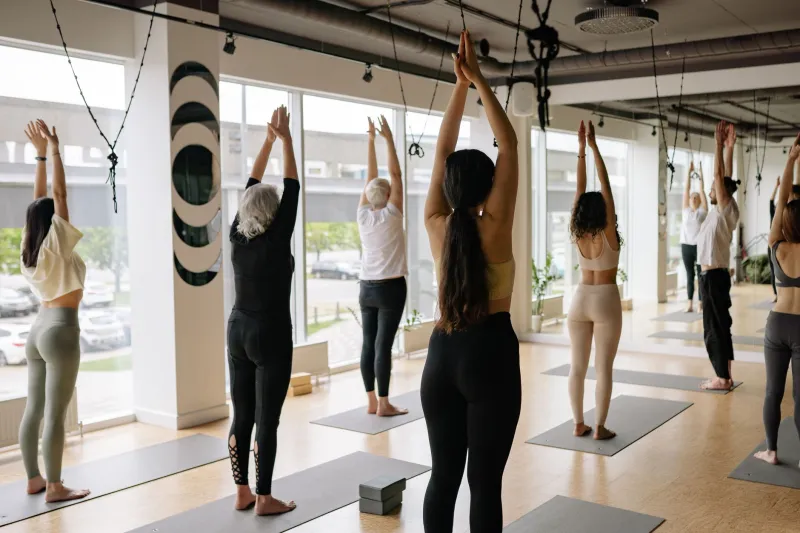
This is why practices like yoga nidra, restorative yoga, and breathwork aren't just wellness extras. They're direct interventions into the nervous system — tools that can gradually teach your body what the neighborhood alone cannot: that it's actually okay to let go.
What Actually Helps (And It's Not Just Moving Somewhere Nicer)
So what does work? A few things that are genuinely supported by research and, frankly, by what we see in the people who come through our studio:
Consistent sleep and wake times. Even on weekends. Your circadian rhythm is a biological clock — it responds to regularity more than to comfort.
Morning light exposure. Step outside within an hour of waking. Astoria has the geography for this. Use it. Natural light in the morning is one of the most powerful signals you can give your internal clock.
A real wind-down buffer. Not just turning off Netflix. An hour — or even thirty minutes — of low stimulation before bed. The body needs a transition, not a hard stop.
Somatic movement practices. Restorative yoga, gentle stretching, even a slow walk — these activate the parasympathetic nervous system and signal to the body that the day is done. Our Wednesday evening restorative class exists for exactly this reason.
Actual support for the underlying stress. Sometimes insomnia is a symptom, not the problem. Therapy, somatic work, or even honest conversations about what's driving the anxiety can address the root rather than just the ceiling-staring symptom.
The Neighborhood Is a Resource, Not a Rescue
Astoria is genuinely a good place to build a healthier life. The green space, the community, the slower pace — these are real assets. But they're inputs, not outcomes. They give you something to work with. They don't do the work for you.
The most honest thing we can say here is this: if you moved here hoping the neighborhood would fix your sleep, you weren't wrong to hope. You were just maybe expecting it to do more of the heavy lifting than any place can. The rest — the actual rest — still comes from inside you.
And that's not a failure. That's just where the real practice begins.