You're Not Failing at Wellness — Wellness Is Failing You

Somewhere between your fourth supplement subscription and your third attempt to meditate for twenty consecutive minutes, something went sideways. What started as a genuine desire to feel better quietly morphed into a relentless productivity project — one with no finish line, no vacation days, and a performance review that comes every single morning when you open your eyes.
Welcome to the wellness optimization trap. Population: a lot of us, including a surprising number of people right here in Astoria.
The Upgrade That Never Ends
Talk to Maria, a 34-year-old teacher who lives off Ditmars Boulevard. She'll tell you she got into wellness after a rough breakup three years ago. Started with yoga — real, humble, beginner yoga. Then came the meditation app. Then the sleep tracker. Then the journal prompts, the cold showers, the adaptogenic mushroom coffee, the binaural beats playlist for deep focus, the red light therapy lamp she bought on sale and now feels vaguely guilty about not using consistently enough.
"At some point I realized I was spending more time managing my wellness routine than actually resting," she said. "And when I skipped something, I didn't just feel tired. I felt like I'd failed."
That feeling — that specific sting of failure — is not a coincidence. It's a business model.
The wellness industry, now valued at over five trillion dollars globally, has found its most loyal customers not among the truly healthy but among the anxious and the perfectionistic. People who respond well to metrics. People who believe, deep down, that if they just optimize hard enough, they can finally outrun whatever is chasing them.
Quantifying Your Way to Exhaustion
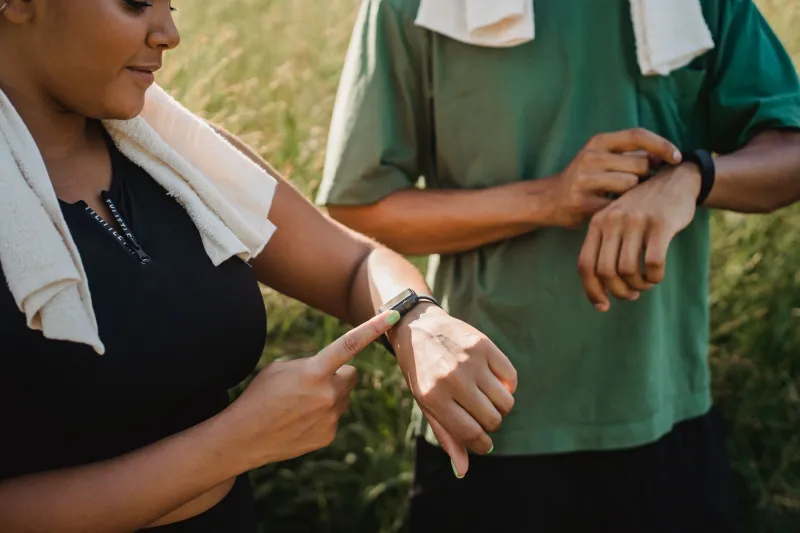
There's a particular flavor of exhaustion that comes from tracking everything. Your steps, your sleep stages, your heart rate variability, your macros, your mood on a scale of one to ten. The promise is clarity — all this data will reveal the levers you need to pull to feel your best. The reality is something more like a low-grade, constant anxiety about whether the numbers are good enough.
Research in behavioral psychology has a name for this: the monitoring trap. When external measurement replaces internal sensation, you stop trusting your own body. You stop eating when you're hungry and start eating when your app says it's time. You stop resting when you're tired and start resting when your recovery score dips below a certain threshold.
The body you were trying to reconnect with gets buried under a dashboard.
Dr. Kristin Neff, whose work on self-compassion has influenced wellness practitioners for decades, has argued consistently that self-improvement culture and self-compassion are often working in direct opposition. One says: you are a project to be completed. The other says: you are a person, already whole, navigating a hard world. The wellness industry has gotten very good at speaking the language of the second while quietly selling you the first.
Astoria's Particular Flavor of This Problem
There's something about this neighborhood that makes the optimization spiral especially sneaky. Astoria draws people who are ambitious, community-oriented, and health-curious — often first-generation or second-generation Americans navigating the particular pressure of proving something, whether to their families or to themselves. The neighborhood's density of yoga studios, juice spots, and wellness boutiques means the infrastructure for self-improvement is everywhere, normalized, practically ambient.
Jordan, a 29-year-old graphic designer who takes classes at a studio near Steinway Street, put it plainly: "Everyone here seems to be working on themselves. It's actually kind of intense. Like, if you're not doing something intentional with your body or your mind, you feel left behind."
That social dimension matters. Wellness stops being personal and starts being comparative. You're not just trying to feel better — you're trying to keep up.
The Exhaustion Is the Point
Here's the uncomfortable truth: an industry that actually made you well would eventually lose you as a customer. The optimization model works precisely because the goalposts keep moving. You hit your step count, so now you need to work on your sleep. You nail your sleep, so now it's time to address your gut microbiome. There is always another layer, another upgrade, another deficiency to correct.
This is not cynicism — it's just market logic. Sustainable wellness doesn't scale. Anxiety does.
The antidote isn't to throw everything out. Yoga is genuinely useful. Breathwork changes lives. Sleep matters enormously. The problem isn't the tools — it's the framework that turns them into a checklist of ways you're falling short.
What a Different Approach Looks Like
It starts with a simple, almost embarrassingly unglamorous question: does this make me feel better, or does it make me feel like I should feel better?
There's a difference. One is grounded in your actual nervous system. The other is rooted in an idea about who you're supposed to be.
It also means getting comfortable with inconsistency — which, for the record, is not the same as giving up. Showing up to your mat three times one week and zero times the next is not failure. It's life. The wellness industry will tell you that consistency is everything, and there's a grain of truth in that, but consistency in the optimization sense has been weaponized into a stick you beat yourself with.
Maria, the teacher from Ditmars, eventually deleted two of her tracking apps. She kept the meditation one but turned off the streak counter. "The second I stopped trying to maintain a streak, I actually started meditating more," she said. "Because it stopped feeling like homework."
That's the move. Not less wellness — just wellness that belongs to you instead of the other way around.