Every Red Light Is a Reset: How Your Astoria Commute Can Become a Daily Mindfulness Practice
Let's be honest. Most of us are not meditating. We want to. We've downloaded the apps, bought the cushion, maybe even lit the candle. But somewhere between the alarm going off and the fourth thing that needs our attention before 8 a.m., the dedicated mindfulness practice quietly slides off the to-do list.
And yet — here you are, every single day, navigating the same stretch of Steinway Street, waiting at the same crosswalk on Ditmars, pressing your MetroCard against the reader at the 30th Avenue station with the same low-grade anxiety about whether the N is running on time. You're already doing something repetitive, predictable, and full of involuntary pauses.
What if that was enough?
The Commute Isn't the Enemy of Your Practice — It Might Be the Practice
There's a reason mindfulness traditions across cultures emphasize ordinary, repetitive activity as a gateway to presence. Walking meditation is a formal practice in Zen Buddhism. Thich Nhat Hanh famously wrote about washing dishes as a form of prayer. The point was never that you needed silence and a mountain view — the point was that awareness can be cultivated anywhere, especially in the places you've stopped paying attention to.
Your Astoria commute is full of those places.
The thing about getting around this particular corner of Queens is that it has a texture to it. It's not the anonymous grind of a midtown office corridor. There's the specific smell of the bakery on 31st that you walk past without registering. There's the pigeon that always seems to be doing something alarming near the trash cans on Broadway. There's the way the light hits the elevated tracks in the late afternoon and turns everything briefly golden. None of this requires you to do anything. It just requires you to notice.
Noticing, it turns out, is the whole game.
Microdosing Presence: What That Actually Means
The term "microdosing" has gotten a lot of mileage in wellness conversations lately, usually in the context of things you ingest. But the concept translates beautifully to mindfulness: small, frequent doses of presence spread throughout your day are often more effective — and far more sustainable — than one long session you're dreading.
A red light is thirty seconds. A platform wait is two to four minutes. The walk from the subway exit to your front door is maybe six. None of these feel like "enough" time to meditate in the traditional sense. But your nervous system doesn't know the difference between a formal breathing exercise and three deliberate breaths you take while waiting for the crosswalk signal to change. The biology is the same.
When you take a slow, intentional exhale — longer than your inhale — you activate the parasympathetic nervous system. Heart rate drops slightly. The stress-response dial turns down a notch. Do that three times at a crosswalk and you've done something real, even if it didn't look like anything from the outside.
The Platform as a Pressure Cooker (and a Proving Ground)
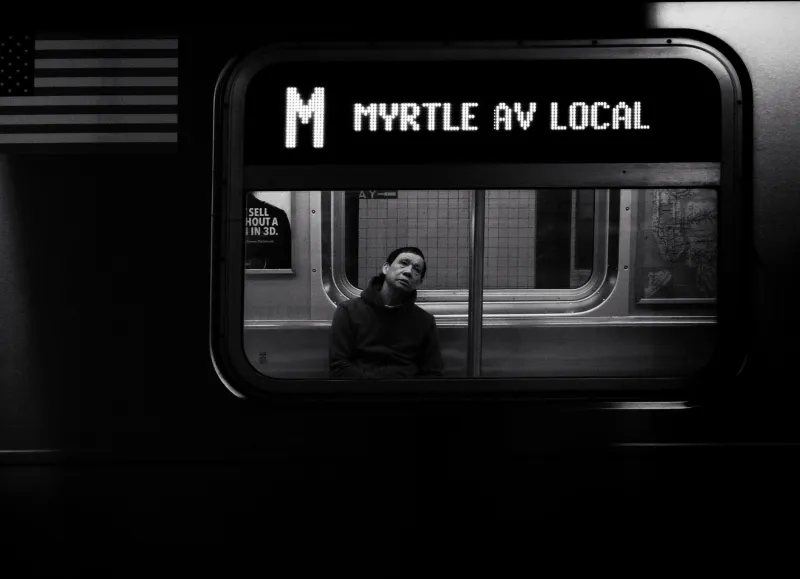
Let's talk about the subway platform, because it deserves its own section. The 30th Avenue stop, the Astoria Boulevard stop, the Ditmars terminus — these are not peaceful places. They are loud, occasionally fragrant in ways you'd rather not analyze, and governed by the whims of the MTA, which operates on its own spiritual timeline.
This is actually ideal training ground.
Mindfulness isn't about achieving a calm, distraction-free mental state. That's a common misconception that keeps a lot of people convinced they're "bad at meditation." Real mindfulness practice is about noticing when your mind has reacted — the spike of irritation when the train is delayed again, the low hum of dread when the platform gets crowded — and then choosing, consciously, what to do with that reaction.
You can't control the F train's schedule. You can notice that your jaw is clenched and consciously release it. You can feel the frustration rise and, instead of feeding it by checking the MTA app for the fourth time, just... let it be there without acting on it. That's the rep. That's the practice.
The platform is hard. That's why it works.
The Walk Home as a Decompression Ritual
The return commute has a different energy, and it's worth treating it differently. Mornings are about activation — getting your nervous system online, preparing for contact with the world. Evenings are about the opposite: transitioning out of the day, shedding the accumulated stress before you walk through your front door and bring it into your home.
The walk from the subway to your apartment is a built-in transition space. Most of us use it to scroll, to call someone back, to mentally rehearse conversations that already happened. All understandable. But even a few minutes of that walk spent with your phone in your pocket and your attention on your feet — the specific weight of each step, the temperature of the air, the sound of the neighborhood settling into evening — creates a genuine neurological buffer between "work mode" and "home mode."
This isn't mystical. It's just giving your brain a moment to change gears instead of asking it to slam from one context directly into another.
A Few Actual Things You Can Try
If you want to make this more concrete, here are some entry points — none of which require anything except the commute you're already taking:
The exhale reset. At any pause — red light, platform wait, elevator — take one breath where the exhale is twice as long as the inhale. Just one. That's it.
Sensory grounding. Pick one sense and spend thirty seconds with it. What can you actually hear right now? Not what you're thinking about — what are you hearing? This is a classic anxiety-interruption technique that also happens to make your commute more interesting.
The arrival breath. Before you swipe into the turnstile in the morning, pause for one full breath. Before you open your apartment door in the evening, same thing. These micro-rituals create psychological bookmarks that help your brain mark transitions.
Phone-free blocks. Choose one segment of your commute — one stop, one block, one platform wait — and commit to keeping your phone away for that stretch. No rules about what to do instead. Just be in the space.
You Already Have the Time
The thing that keeps most people from building a mindfulness practice isn't laziness or lack of interest. It's the belief that it requires a kind of time and stillness that modern life simply doesn't offer. That belief, while understandable, is also a way of outsourcing your wellbeing to ideal conditions that may never arrive.
Astoria is not a quiet place. It's layered and loud and relentlessly alive. But that aliveness — the crosswalks, the platforms, the walk past the same deli you've walked past a thousand times — is already a practice in miniature, waiting for you to show up to it.
You don't need to carve out more time. You need to inhabit the time you're already in.
The light is about to change. Take a breath.