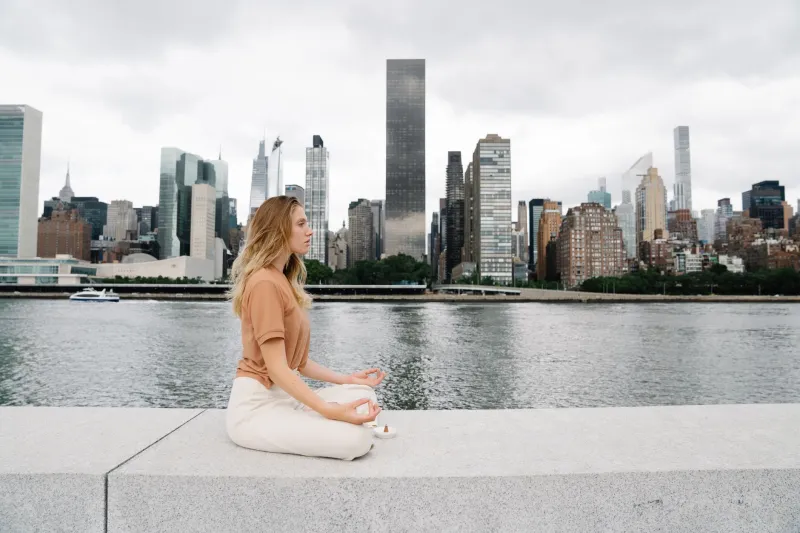
Your Zip Code Is a Wellness Practice: How Astoria's Streets Shape Your Nervous System
Let's get something out of the way first. You can have the most dialed-in morning routine in Queens—cold water, ten minutes of breathwork, a gratitude journal that's actually getting used—and still walk out your front door into conditions that immediately start undoing all of it. That's not a motivation problem. That's a geography problem.
Where you live is not a passive backdrop to your wellness journey. It is an active, ongoing input into your nervous system, your hormone levels, your sleep quality, and your mental health. And for people living in dense urban neighborhoods like Astoria, that input is loud, layered, and often working against you in ways that are genuinely worth understanding.
The Science of Environmental Stress (And Why It's Not in Your Yoga App)
Your autonomic nervous system doesn't clock out when your meditation timer goes off. It's running constantly, scanning your environment for signals of safety or threat. Researchers call this process neuroception—your nervous system's unconscious surveillance of the world around you. The problem is that it can't always distinguish between a genuine emergency and the low-grade chaos of a busy urban block.
Chronic noise exposure is one of the most underappreciated health stressors in city life. The World Health Organization has linked traffic noise specifically to elevated cortisol, disrupted sleep architecture, and increased cardiovascular risk. If you live near the BQE, an elevated subway line, or a commercial corridor that never really quiets down, your body is absorbing that stress whether you're consciously aware of it or not. Your nervous system doesn't get to vote on whether it cares.
Air quality is another variable that rarely makes it into wellness conversations, even though the evidence is damning. Particulate matter from traffic and industrial sources has been linked to neuroinflammation, mood disruption, and cognitive fatigue. Neighborhoods in the outer boroughs—including parts of Astoria that sit close to the Grand Central Parkway or industrial waterfront zones—carry measurably different air quality profiles than, say, the Upper West Side. That's not a conspiracy theory. That's EPA monitoring data.
Green Space Isn't a Luxury. It's a Nervous System Reset Button.
Here's something the wellness industry gets right, even if it doesn't always frame it this way: access to nature genuinely changes your physiology. Time spent in green environments reduces cortisol, lowers blood pressure, and activates the parasympathetic nervous system—the part that handles rest, digestion, and recovery. Japanese researchers have studied this under the term shinrin-yoku, or forest bathing, and the findings are consistent enough to be taken seriously.
Astoria Park is not a forest. But it's also not nothing. The combination of the waterfront, tree cover, and physical separation from traffic noise creates a genuinely different sensory environment than the surrounding blocks. If you're using that park only for weekend runs, you're leaving a significant wellness resource underutilized. Even 20 minutes of slow, unstructured time in a green space has been shown to meaningfully shift nervous system tone.
The real issue is access and habit. If your daily life doesn't route you through green space—if it routes you through a parking lot, a subway platform, and a fluorescent-lit office instead—your nervous system is getting a very specific diet of inputs, and it's not a balanced one.
Community Density as a Double-Edged Variable
Astoria has something that a lot of wellness-focused neighborhoods have actually lost: genuine community vibrancy. The corner stores, the multilingual block parties, the sense that your neighbors are real people you might actually know—this is not just culturally nice. It's physiologically meaningful.
Social connection is one of the most robust predictors of long-term health outcomes we have. Loneliness, by contrast, has been compared to smoking 15 cigarettes a day in terms of mortality risk. Dense, mixed-use neighborhoods like Astoria can actually protect against social isolation in ways that wealthier, more privatized communities don't.
But density also brings friction. Crowded subway cars, sidewalk congestion, neighbor noise, the constant low-level negotiation of shared space—these are real stressors too. The key is recognizing that your neighborhood is not uniformly good or bad for your health. It's a complex mix of inputs, and your job is to get intentional about which ones you're absorbing and which ones you're mitigating.
Practical Strategies for Optimizing Your Environment (Not Just Your Inner Life)
You don't need to move to get the benefits of a healthier environment. But you do need to stop treating your surroundings as fixed and start treating them as something you can actually work with.
Audit your sensory environment at home. Noise, light, and air quality inside your apartment are things you have more control over than you might think. A white noise machine near the bedroom window, blackout curtains, an air purifier with a HEPA filter—these are not luxuries. They're nervous system interventions with real evidence behind them.
Build a green space habit, not just a green space intention. Put Astoria Park, Rainey Park, or even a tree-lined block into your actual weekly schedule the same way you'd schedule a class. Unstructured time outdoors, without headphones or a destination, is the goal.
Rethink your commute route. If you have any flexibility, routing yourself through quieter streets or past green space on the way to the subway can meaningfully shift your starting nervous system state for the workday. Small, consistent exposures add up.
Notice your home's social texture. Are you actually connecting with neighbors, or just coexisting with them? A brief real conversation with someone on your block does something physiologically different than scrolling through a community Facebook group.
Advocate for your block. This one's bigger and slower, but it matters. Street trees, traffic calming measures, cleaner bus routes—these are public health interventions. Showing up for local community board meetings is, genuinely, a wellness practice.
The Inner Work Still Matters. It Just Doesn't Work in Isolation.
None of this is an argument against meditation, yoga, or any of the internal practices that actually help people. It's an argument for expanding your definition of what counts as a wellness practice in the first place.
Your nervous system doesn't live inside your head. It lives in your body, on your block, in your building, in the air you're breathing right now. The most sophisticated mindfulness practice in the world is still operating inside an environment that either supports or undermines it.
In Astoria, we have a genuinely complex, layered, sometimes overwhelming urban environment. That's also what makes it interesting, human, and worth fighting for. Start by paying attention to what it's actually doing to you—and then get strategic about it. Your zip code is already a wellness practice. The question is whether it's working for you or against you.